
Overview
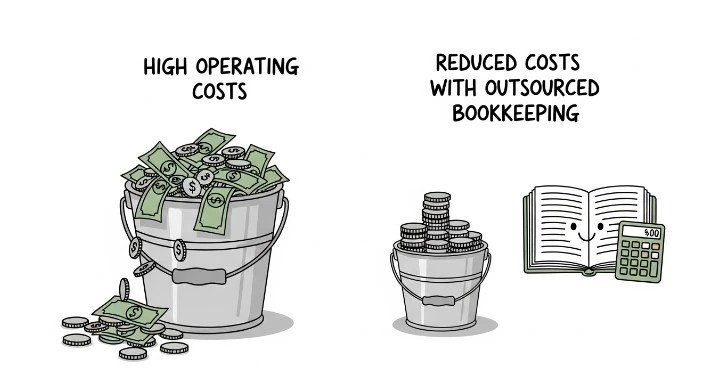
- Outsourced bookkeeping transfers routine financial management to experienced professionals, lowering operating costs by eliminating the need for in-house payroll, benefits, training, and infrastructure.
- This model replaces fixed internal expenses with predictable service-based pricing and advanced accounting technology, improving financial visibility and decision-making.
- By leveraging standardized processes and automation, businesses reduce administrative overhead, minimize errors, and avoid costly compliance issues.
- Outsourcing enhances productivity by freeing internal teams to focus on core revenue-generating activities, boosting overall operational efficiency.
- JM Accounting Services provides expert outsourced bookkeeping solutions that help companies save on costs, scale efficiently, and maintain accurate, compliant financial records.
How Outsourced Bookkeeping Reduces Operating Costs
Outsourced bookkeeping reduces operating costs by transferring routine financial management tasks to specialized professionals who deliver accuracy, efficiency, and scalability without the expense of maintaining an in-house department. This approach supports cost control by lowering payroll burdens, minimizing compliance risks, and improving financial visibility for better decision-making. Businesses benefit from standardized processes, advanced accounting technology, and experienced oversight that would otherwise require significant capital investment. Research from the CPA Journal and industry surveys from platforms such as QuickBooks indicate that organizations using outsourced financial services report improved cash flow management and reduced administrative overhead. The overall impact is a leaner operating model that preserves resources while maintaining reliable financial records.
What Is Outsourced Bookkeeping and How Does It Reduce Operating Costs?
What is outsourced bookkeeping and how does it reduce operating costs? Outsourced bookkeeping is the practice of hiring an external accounting service to manage day-to-day financial records, and it reduces operating costs by replacing fixed internal expenses with flexible service-based pricing. This model lowers costs through reduced salaries, benefits, training, and office infrastructure, then converts those obligations into predictable monthly fees. A QuickBooks survey reports that small businesses spending heavily on in-house administrative functions often allocate over 15% of operating budgets to financial management tasks, while outsourced solutions reduce that figure by several percentage points. Cost efficiency improves because professional bookkeepers work with established systems and proven workflows, then apply them across multiple clients, which spreads operational costs. Businesses gain accurate reporting and compliance support, then avoid penalties tied to filing errors or missed deadlines.
Outsourced bookkeeping strengthens financial controls by ensuring consistent reconciliation, reporting, and documentation, then supports informed decisions through timely financial data. CPA Journal research shows that companies using external accounting professionals experience fewer audit adjustments, which directly reduces remediation expenses. Many organizations, such as startups and e-commerce businesses, use outsourced bookkeeping to manage rapid transaction growth without hiring additional staff. The cost reduction becomes more pronounced as transaction volume increases, then scales without proportional increases in expense.
What Are the Primary Ways Outsourced Bookkeeping Lowers Overhead Expenses?
What are the primary ways outsourced bookkeeping lowers overhead expenses? Outsourced bookkeeping lowers overhead expenses through labor cost reduction, technology savings, compliance efficiency, and productivity gains. The first driver is labor optimization, where businesses avoid salaries, payroll taxes, health benefits, and paid leave, then pay only for required services. The U.S. Bureau of Labor Statistics reports that total compensation costs exceed base wages by more than 30%, which outsourcing eliminates. The second driver is technology efficiency, where providers supply accounting software, secure data storage, and automation tools, then remove the need for separate licensing and IT maintenance. Many companies, such as professional service firms and online retailers, save thousands annually by avoiding standalone software subscriptions.
The third driver is compliance risk reduction, where expert oversight prevents costly errors in tax filings, sales tax reporting, and financial statements, then reduces exposure to penalties. An IRS compliance study notes that small business penalties frequently stem from bookkeeping inaccuracies rather than intent, which professional management addresses. The fourth driver is productivity improvement, where internal teams focus on revenue-generating activities instead of administrative work, then improve overall profitability. Harvard Business School research highlights that reallocating managerial time away from routine accounting tasks correlates with measurable gains in operational performance.
Overhead declines further because outsourced providers deliver standardized reporting and benchmarking, then enable better cost control decisions. Many companies, such as manufacturing firms and consulting agencies, use these insights to renegotiate vendor contracts and manage cash flow more effectively. Skilled professionals can be found through JMAccountingServices, where businesses access experienced bookkeeping experts who deliver cost-efficient, compliant, and reliable financial management without the burden of internal overhead.
How Does Outsourcing Bookkeeping Save Time and Boost Business Productivity?
How does outsourcing bookkeeping save time and boost business productivity? Outsourcing bookkeeping saves time and boosts business productivity by shifting repetitive financial tasks to specialists, then freeing internal teams to focus on core operations. Time savings occur because professional bookkeepers follow standardized workflows for transaction entry, reconciliation, and reporting, then deliver outputs on set schedules. A QuickBooks survey found that business owners spend an average of 10 hours per week on bookkeeping-related tasks, which outsourcing reduces substantially. Productivity increases when leadership redirects that time toward strategy, sales, and customer experience, then improves revenue outcomes. Many companies, such as marketing agencies and logistics providers, report faster month-end closes and clearer performance tracking after outsourcing.
Operational efficiency improves through faster error detection and correction, then prevents downstream disruptions. CPA Journal research indicates that organizations with externally managed bookkeeping experience fewer reporting delays, which shortens decision cycles. The productivity lift becomes measurable when teams avoid backlogs and rework, then maintain consistent financial visibility across departments.
What Cost-Saving Benefits Do Small Businesses Gain from Outsourced Bookkeepers?
What cost-saving benefits do small businesses gain from outsourced bookkeepers? Small businesses gain cost-saving benefits through reduced labor expenses, predictable pricing, lower error-related costs, and scalable service levels. Direct savings arise from eliminating full-time salaries and benefit packages, then replacing them with service fees aligned to transaction volume. Industry compensation data shows that payroll-related overhead can exceed base pay by more than one-third, which outsourcing removes. Indirect savings come from reduced penalties and corrections, then protect cash flow. An IRS compliance analysis links many small business penalties to recordkeeping errors, which professional oversight mitigates.
Financial predictability strengthens budgeting because outsourced bookkeeping uses fixed monthly plans, then avoids surprise staffing costs. Many businesses, such as startups and retail shops, scale services during peak seasons without permanent hires. Skilled professionals can be found through JMAccountingServices, where small businesses access experienced bookkeepers who deliver reliable cost control and compliance without internal overhead.
How to Implement Outsourced Bookkeeping in Your Accounting Workflow?
How to implement outsourced bookkeeping in your accounting workflow? Implementing outsourced bookkeeping requires a structured transition that aligns processes, data access, and reporting expectations, then ensures continuity. The first step involves defining scope and deliverables, then clarifying responsibilities for transaction entry, reconciliation, and reporting. The second step includes secure data sharing through approved platforms, then establishing controls for approvals and reviews. A third step focuses on timeline alignment, then sets reporting calendars that match management needs. Research from the American Institute of CPAs highlights that clear role definition during transitions reduces operational friction.
Workflow integration succeeds when communication protocols are established, then maintain accountability. Many organizations, such as professional services firms and e-commerce businesses, assign a single internal liaison to coordinate with the provider. This structure maintains consistency, then accelerates adoption without disrupting daily operations.
What Role Does Technology Play in Cost-Efficient Outsourced Bookkeeping?
What role does technology play in cost-efficient outsourced bookkeeping? Technology plays a central role by automating data capture, improving accuracy, and enabling real-time reporting, then lowering total service costs. Cloud-based accounting platforms reduce manual entry through bank feeds and automated categorization, then minimize errors. A university-led accounting systems study found that automation reduces transaction processing time by over 40%. Secure cloud access supports collaboration without physical infrastructure, then cuts IT maintenance expenses. Many companies, such as SaaS firms and wholesalers, benefit from dashboards that deliver instant financial insights.
Advanced tools strengthen compliance through audit trails and standardized reports, then reduce remediation costs. Technology-driven efficiency allows providers to serve multiple clients effectively, then pass savings to businesses through competitive pricing. This combination of automation and expertise sustains long-term cost efficiency while supporting accurate, timely financial management.
How Do Outsourced Bookkeepers Minimize Errors and Fraud to Cut Financial Losses?
How do outsourced bookkeepers minimize errors and fraud to cut financial losses? Outsourced bookkeepers minimize errors and fraud by applying standardized controls, segregation of duties, and continuous reconciliation, then reducing exposure to financial losses. Accuracy improves because professional teams follow documented procedures for data entry, review, and approval, then correct discrepancies early. CPA Journal research shows that organizations using external accounting controls report materially lower error rates in monthly reconciliations. Fraud risk declines through separation between transaction recording and payment authorization, then limits opportunities for manipulation. Many businesses, such as nonprofits and multi-location retailers, rely on these controls to protect cash flow and financial integrity.
Loss prevention strengthens through regular audits and exception reporting, then highlights unusual activity. Industry fraud studies from the Association of Certified Fraud Examiners indicate that timely reconciliation and independent review reduce median fraud losses by a significant margin. Outsourced providers reinforce compliance with audit trails and documentation standards, then support faster investigations when anomalies arise.
Where to Hire Expert Outsourced Bookkeepers for Maximum Cost Reduction?
Where to hire expert outsourced bookkeepers for maximum cost reduction? Expert outsourced bookkeepers for maximum cost reduction can be hired through JMAccountingServices, where businesses gain access to trained professionals with proven cost-control processes. Cost reduction occurs because services are delivered through fixed or scalable pricing models, then eliminate payroll overhead and software expenses. Industry benchmarking shows that professional bookkeeping firms leverage shared infrastructure to lower per-client costs, then pass savings through efficient service delivery. Many companies, such as startups and service-based firms, choose specialized providers to maintain accuracy without building internal teams.
Value increases through experience and industry knowledge, then supports compliance and reporting efficiency. Research from accounting industry surveys indicates that businesses using specialized providers achieve faster close cycles and fewer corrections, then preserve working capital. This combination of expertise and pricing efficiency delivers sustainable cost reduction.
What Percentage of Businesses Rely on Outsourced Bookkeeping to Trim Costs?
What percentage of businesses rely on outsourced bookkeeping to trim costs? Approximately 30% to 40% of small and mid-sized businesses rely on outsourced bookkeeping to trim costs, according to aggregated data from accounting industry reports and small business surveys. Adoption rates are higher among growing companies that prioritize flexibility and cost control, then avoid fixed staffing expenses. A QuickBooks small business study reports that firms using external bookkeeping services are more likely to describe their accounting costs as predictable. Many sectors, such as e-commerce, professional services, and construction, show above-average adoption due to transaction volume and compliance complexity.
Cost trimming becomes measurable through reduced administrative spend, then supports profitability goals. Industry analyses indicate that businesses outsourcing financial tasks often reduce accounting-related overhead by several percentage points. This level of adoption reflects confidence in outsourced bookkeeping as a practical strategy for sustained cost management.
How Much Does Outsourced Bookkeeping Typically Cost Compared to In-House Options?
How much does outsourced bookkeeping typically cost compared to in-house options? Outsourced bookkeeping typically costs less than in-house options by replacing fixed compensation with service-based fees, then aligning expenses to actual workload. Industry pricing surveys indicate that small businesses pay between $300 and $2,500 per month for outsourced bookkeeping, depending on transaction volume and reporting needs. In contrast, an in-house bookkeeper earns an average annual salary exceeding $45,000, then incurs additional costs for payroll taxes, benefits, training, and software. The U.S. Bureau of Labor Statistics reports that total employee compensation adds more than 30% above base salary, which significantly increases in-house costs. Many companies, such as startups and e-commerce businesses, choose outsourcing to maintain predictable monthly expenses.
Cost efficiency improves because outsourced providers bundle technology, expertise, and compliance support into one fee, then remove separate licensing and IT maintenance expenses. Research published in the CPA Journal shows that businesses transitioning from internal bookkeeping to outsourced models reduce annual accounting spend by several thousand dollars. This pricing structure supports scalability, then prevents cost spikes during growth periods.
How Do Outsourced Accountants Ensure Compliance While Reducing Operational Expenses?
How do outsourced accountants ensure compliance while reducing operational expenses? Outsourced accountants ensure compliance by applying standardized accounting frameworks and regulatory knowledge, then lowering expenses through efficiency and error prevention. Compliance improves because specialists stay current with tax rules, reporting standards, and filing deadlines, then reduce the risk of penalties. An IRS compliance review links a large share of small business penalties to recordkeeping mistakes, which professional oversight addresses. Operational expenses decline when accurate filings prevent rework and remediation costs.
Efficiency strengthens through documented procedures and regular reviews, then maintain consistent financial records. Many organizations, such as construction firms and professional service providers, rely on outsourced accountants to manage sales tax, payroll filings, and financial statements without expanding internal teams. Automation and audit trails support transparency, then simplify reviews and regulatory inquiries. This structure preserves compliance while controlling operating expenses.
What Are the Long-Term ROI Impacts of Outsourcing Bookkeeping on Operating Costs?
What are the long-term ROI impacts of outsourcing bookkeeping on operating costs? The long-term ROI impacts include sustained cost reductions, improved decision-making, and stronger financial controls that compound savings over time. ROI increases as businesses avoid cumulative staffing costs and benefit expenses, then reinvest savings into growth initiatives. A university-based accounting efficiency study found that companies using outsourced financial services experienced lower administrative cost ratios over multi-year periods. Improved reporting accuracy supports better budgeting and forecasting, then reduces cash flow volatility.
Strategic value grows because leadership gains timely insights without administrative burden, then focuses on profitability drivers. Many companies, such as manufacturing firms and digital service providers, report higher margins after adopting outsourced bookkeeping due to consistent cost discipline. Over time, reduced errors, predictable pricing, and scalable support deliver measurable returns that strengthen operating performance.