
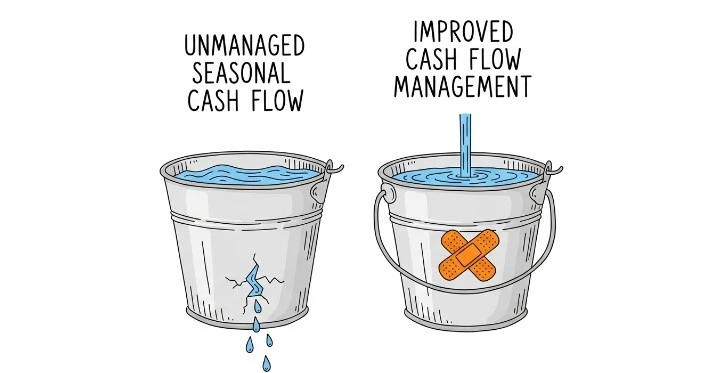
Overview
- Effective cash flow management helps seasonal businesses maintain stability during slow periods while maximizing revenue during peak seasons.
- Structured bookkeeping and forecasting allow business owners to anticipate fluctuations, manage expenses, and plan reserves ahead of off-season downturns.
- Using real-time financial tracking tools provides clear visibility into income cycles, receivables, and payables, supporting smarter cash flow decisions year-round.
- Poor cash flow planning in seasonal businesses can lead to missed payroll, delayed vendor payments, or reliance on costly short-term financing.
- JMAccountingServices supports seasonal businesses with tailored cash flow management strategies that improve liquidity, forecasting accuracy, and long-term financial resilience.
How to Improve Cash Flow Management in Seasonal Businesses
Strong cash flow management is the foundation of survival and growth for seasonal businesses that experience predictable peaks and valleys in revenue throughout the year. This article provides a comprehensive overview of how seasonal revenue cycles affect cash availability, why planning matters more in these businesses than in steady-income models, and how disciplined forecasting helps owners make informed operational decisions. The discussion explains common structural challenges faced by seasonal enterprises, such as delayed receivables and fixed overhead during low-demand periods, and connects those challenges to practical financial strategies supported by industry research. The goal is to present clear, evidence-based guidance that aligns with best practices recognized by accounting professionals and small business studies, while maintaining a practical focus on real-world business operations.
What Are the Unique Cash Flow Challenges in Seasonal Businesses?
The unique cash flow challenges in seasonal businesses are driven by uneven revenue timing, fixed operating expenses, and mismatched inflows and outflows across the year. Many seasonal companies, such as tourism operators, agricultural suppliers, event-based vendors, and holiday retail businesses, earn a large percentage of annual revenue within a short window while covering expenses year-round. According to a U.S. Small Business Administration financial trends report, more than 60% of seasonal businesses report cash shortages during off-peak months despite being profitable on an annual basis. This imbalance creates pressure on working capital and limits flexibility when unexpected costs arise.
One major challenge is the persistence of fixed costs during low-revenue periods. Expenses such as rent, insurance premiums, software subscriptions, utilities, and minimum staffing levels continue regardless of sales volume. A CPA Journal analysis on small business liquidity notes that fixed overhead can consume over 40% of annual cash outflows for seasonal firms, increasing the risk of short-term insolvency even when long-term profitability is strong. The statement is clear that cash constraints emerge during slow periods, then the condition follows that revenue does not align evenly with expense schedules.
Another challenge involves delayed customer payments during peak seasons. Many seasonal businesses extend trade credit to attract bulk orders or corporate clients, which leads to accounts receivable piling up when cash is needed most. A QuickBooks Small Business Cash Flow Survey found that businesses waiting more than 30 days for payment were twice as likely to experience cash stress during off-peak months. This creates a timing gap where sales appear strong on paper, yet usable cash remains limited.
Inventory and upfront cost pressures further complicate cash flow. Seasonal companies often invest heavily before the peak season begins, purchasing inventory, marketing campaigns, equipment rentals, or temporary staff training in advance. Examples include ski resorts preparing gear before winter or landscaping companies acquiring materials before spring demand. An MIT Sloan study on working capital management highlights that upfront seasonal investment can account for 50–70% of annual cash outlay before revenue is realized, amplifying the importance of disciplined planning.
Why Is Cash Flow Forecasting Essential for Seasonal Businesses?
Yes, cash flow forecasting is essential for seasonal businesses because it provides visibility into future cash positions before revenue declines or expenses surge. Forecasting transforms historical data, current obligations, and expected sales patterns into a forward-looking financial map that supports informed decision-making. Research published by Harvard Business School indicates that companies using rolling cash flow forecasts are 30% more likely to maintain adequate liquidity during revenue downturns than those relying on static budgets.
Cash flow forecasting allows business owners to anticipate shortfalls early, then respond with measured adjustments rather than reactive decisions. The statement emphasizes preparedness, then the condition follows that seasonal downturns are predictable but financially damaging without advance planning. For example, a forecast may reveal that cash reserves drop below safe levels two months before the off-season begins, prompting earlier cost controls or financing arrangements.
Forecasting improves expense timing and prioritization by aligning payments with expected inflows. Seasonal businesses can use forecasts to schedule discretionary spending, negotiate vendor payment terms, or defer non-critical purchases. A University of Chicago Booth School of Business study on financial planning found that businesses with monthly cash projections reduced late-payment penalties by nearly 25% compared to those without structured forecasts. This discipline protects margins and preserves vendor relationships.
Access to financing improves when forecasts are accurate and well-documented. Lenders and investors evaluate projected cash flow to assess repayment capacity, especially for businesses with cyclical income. According to the Federal Reserve Small Business Credit Survey, companies that presented clear cash flow projections were approved for credit at higher rates than peers lacking formal forecasts. Seasonal businesses benefit from this credibility when securing lines of credit to bridge off-peak periods.
Forecasting supports strategic growth decisions by clarifying when expansion is financially viable. Many companies, such as seasonal e-commerce brands and hospitality operators, misjudge growth timing by focusing on peak revenue rather than year-round liquidity. Cash flow projections highlight whether surplus funds during busy months are sufficient to support hiring, equipment purchases, or new locations without jeopardizing stability during slower periods.
For businesses seeking professional support, skilled professionals can be found through JMAccountingServices, where forecasting models, cash flow analysis, and seasonal planning frameworks are tailored to cyclical revenue structures. This targeted expertise strengthens accuracy and ensures that forecasts reflect both industry benchmarks and business-specific realities.
In summary, seasonal businesses face predictable yet complex cash flow challenges rooted in revenue timing, fixed expenses, and upfront investments. Cash flow forecasting stands as a critical management tool that converts these challenges into manageable financial patterns, supported by research, data, and professional accounting standards.
How Can Seasonal Businesses Build Cash Reserves During Peak Seasons?
Seasonal businesses can build cash reserves during peak seasons by deliberately converting high-revenue periods into long-term liquidity buffers rather than short-term spending opportunities. This approach requires treating surplus cash as a strategic asset earmarked for future stability, then the condition follows that peak demand will inevitably decline. Industry data from the QuickBooks Cash Flow Survey shows that businesses that allocate at least 20% of peak-season net inflows to reserves are 35% more likely to avoid borrowing during off-peak months.
One effective method is establishing an automated reserve allocation tied to revenue thresholds. When sales exceed forecasted baselines, a predefined percentage is transferred into a separate reserve account. This structure removes emotion from decision-making and reinforces consistency. Examples include hospitality operators and seasonal retailers who set aside surplus funds weekly during high-traffic months to cover fixed costs later in the year.
Debt reduction during peak seasons strengthens reserve-building efforts by lowering future cash obligations. Paying down high-interest balances improves monthly cash availability once revenue slows. A CPA Journal analysis indicates that seasonal firms prioritizing debt reduction during strong months reduced off-season cash strain by nearly 28%. This practice creates flexibility when income contracts.
Tax planning plays a supporting role in reserve growth by preventing surprise liabilities. Setting aside estimated tax payments from peak earnings protects reserves from depletion. Many companies, such as construction firms and agricultural suppliers, improve reserve stability by separating operating cash from tax-designated funds early in the season.
What Strategies Help Diversify Revenue in Seasonal Businesses?
Strategies that help diversify revenue in seasonal businesses focus on smoothing income across the calendar year while leveraging existing capabilities. Revenue diversification reduces dependence on a single high-demand period, then the condition follows that core offerings fluctuate seasonally. Research from Stanford Graduate School of Business shows that businesses with at least two complementary revenue streams experience 22% lower cash volatility than single-stream seasonal models.
One strategy involves introducing counter-seasonal products or services that align with existing expertise. For example, a landscaping company may offer snow removal services in winter, and a summer tourism operator may sell digital guides or branded merchandise year-round. These extensions use existing infrastructure while creating incremental cash inflows.
Subscription-based or recurring revenue models provide predictable income outside peak cycles. Seasonal businesses adopt maintenance plans, memberships, or service retainers to stabilize cash flow. According to a McKinsey small business revenue study, recurring revenue sources increase cash predictability and improve forecasting accuracy by over 30%.
Partnerships and wholesale channels expand reach without heavy upfront investment. Many seasonal brands, such as specialty food producers and event vendors, generate off-season revenue by supplying partners or licensing products. Diversification through partnerships spreads risk while preserving operational focus.
How Do Cost Control Measures Improve Cash Flow in Off-Peak Periods?
Cost control measures improve cash flow in off-peak periods by reducing fixed outflows and aligning expenses with reduced revenue levels. The statement emphasizes efficiency, then the condition follows that demand declines while many costs remain constant. A Federal Reserve small business liquidity report notes that firms implementing structured cost controls cut off-season cash burn by an average of 18%.
Flexible staffing models are a primary cost-control lever. Seasonal businesses adjust labor through temporary contracts, reduced hours, or cross-trained employees. Examples include retail stores scaling staff post-holiday season and event companies shifting crews to project-based schedules. Labor flexibility protects cash without compromising service quality during peaks.
Vendor renegotiation strengthens cash flow by improving payment timing and pricing. Businesses that negotiate extended payment terms or seasonal pricing reduce immediate cash pressure. An NYU Stern working capital study found that extending average payables by even 10 days improved short-term liquidity metrics for seasonal firms.
Technology-driven efficiency lowers operating costs during slow periods. Automating billing, inventory tracking, and customer communications reduces manual labor expenses. Many companies, such as e-commerce sellers and service providers, report measurable cash savings after streamlining administrative workflows.
What Role Does Inventory Management Play in Seasonal Cash Flow?
Inventory management plays a central role in seasonal cash flow by determining how much capital is tied up before, during, and after peak demand. Excess inventory restricts liquidity, then the condition follows that unsold goods generate storage costs and markdown losses. A Wharton School supply chain study found that poor inventory alignment accounted for up to 25% of cash flow strain in seasonal retail businesses.
Demand forecasting improves inventory decisions by matching stock levels to realistic sales expectations. Seasonal businesses use historical data, market trends, and pre-orders to avoid overbuying. Examples include apparel retailers ordering limited seasonal collections and agricultural suppliers aligning inventory with planting cycles.
Just-in-time purchasing reduces cash tied up in unsold stock by synchronizing procurement with demand. This approach minimizes upfront outlays while maintaining availability. According to an MIT Center for Transportation and Logistics report, businesses using just-in-time principles improved cash turnover ratios by over 20%.
Clear inventory exit strategies protect cash after peak seasons. Planned discounts, bundled offers, or secondary sales channels convert remaining stock into usable cash before storage costs escalate. Many seasonal companies preserve liquidity by treating inventory liquidation as a planned phase rather than a reactive response.
For businesses seeking structured guidance across reserves, diversification, cost control, and inventory planning, skilled professionals can be found through JMAccountingServices, where seasonal cash flow strategies are designed to support long-term financial resilience.
How Can Negotiating Supplier Terms Benefit Seasonal Businesses?
Negotiating supplier terms benefits seasonal businesses by improving payment flexibility, preserving working capital, and reducing cash pressure during low-revenue periods. The statement highlights financial relief, then the condition follows that seasonal income does not align evenly with expense timing. Research published in the CPA Journal shows that small businesses negotiating extended payment terms improved short-term liquidity ratios by an average of 15%, a meaningful margin for firms facing cyclical downturns.
Extended payment terms allow businesses to delay cash outflows until revenue is realized. Seasonal companies, such as agricultural distributors and tourism operators, benefit when suppliers agree to net-45 or net-60 terms during off-peak months. This adjustment aligns expenses with incoming cash rather than forcing upfront payments that strain reserves. A Wharton School working capital study found that even modest extensions in payables reduced reliance on short-term borrowing among seasonal firms.
Volume-based pricing and seasonal discounts further enhance cash efficiency. Suppliers often prefer predictable, long-term relationships over transactional sales. Businesses that commit to annual purchase volumes or early-season orders gain leverage to negotiate lower per-unit costs. Examples include retailers securing pre-season inventory discounts and event companies locking in annual service contracts. Lower costs translate directly into stronger margins and improved cash availability.
Supplier negotiations strengthen planning and predictability. Clear agreements around pricing, delivery schedules, and payment expectations reduce uncertainty. This stability improves cash flow forecasting accuracy, which Harvard Business Review research links to better operational decisions and reduced financial stress in cyclical businesses.
What Financing Options Are Available for Seasonal Cash Flow Gaps?
Financing options available for seasonal cash flow gaps include short-term credit tools, revenue-based financing, and structured lending products designed to bridge predictable income fluctuations. These options address timing mismatches between expenses and revenue, then the condition follows that seasonal downturns are known in advance. According to the Federal Reserve Small Business Credit Survey, more than 40% of seasonal businesses rely on external financing at least once per year to maintain operations during slow periods.
Lines of credit provide flexible access to funds that can be drawn and repaid as needed. Seasonal businesses use lines of credit to cover payroll, inventory purchases, and fixed expenses during off-peak months. Unlike term loans, interest accrues only on borrowed amounts, preserving affordability when used responsibly.
Revenue-based financing aligns repayments with cash inflows. Payments fluctuate based on sales volume, which reduces pressure during slow periods. This structure benefits businesses with strong peak revenue but inconsistent monthly income, such as e-commerce brands and hospitality operators. Industry data from McKinsey indicates that revenue-linked repayment models lower default risk in seasonal sectors.
Short-term loans and invoice financing convert future revenue into immediate cash. Invoice financing accelerates access to funds tied up in receivables, a common challenge for seasonal companies offering trade credit. Examples include wholesalers and service providers receiving early payment against outstanding invoices. A University of Pennsylvania finance study found that receivables-based financing improved cash cycle efficiency without increasing long-term debt exposure.
For businesses evaluating financing strategies alongside forecasting and cash planning, skilled professionals can be found through JMAccountingServices, where funding decisions are aligned with seasonal cash patterns and risk tolerance.
What Is Cash Flow Management in Seasonal Businesses?
Cash flow management in seasonal businesses is the process of planning, monitoring, and controlling cash inflows and outflows to remain solvent throughout fluctuating revenue cycles. The statement establishes control, then the condition follows that income concentrates within limited periods of the year. Effective cash flow management ensures that peak-season earnings support year-round operations rather than masking underlying liquidity risks.
This process involves forecasting future cash positions based on historical seasonality, current obligations, and expected sales. Businesses use forecasts to anticipate shortages, schedule expenses, and allocate reserves. Research from Harvard Business School shows that companies using rolling cash flow forecasts maintain higher liquidity and experience fewer emergency financing events.
Expense alignment is a core element of seasonal cash flow management. Fixed and variable costs are reviewed to ensure spending matches realistic revenue expectations. Examples include adjusting staffing levels, renegotiating vendor contracts, and deferring discretionary expenses during slow periods. A Stanford Graduate School of Business study links disciplined expense alignment to improved cash survival rates in cyclical industries.
Reserve planning and monitoring complete the cash management framework. Profitable seasonal businesses separate surplus funds during peak months to cover future obligations. This practice transforms volatility into predictability and supports long-term stability. Industry benchmarks from the Small Business Administration confirm that businesses maintaining cash reserves equal to three to six months of fixed expenses demonstrate stronger resilience during revenue declines.
In summary, cash flow management in seasonal businesses integrates forecasting, expense control, financing strategy, and reserve planning into a cohesive system that sustains operations across fluctuating demand cycles.
How to Implement Cash Flow Management in Accounting?
Cash flow management in accounting is implemented by establishing structured processes that track, forecast, and control cash movements in alignment with seasonal revenue patterns. The statement emphasizes structure, then the condition follows that seasonal income fluctuates across defined periods. Effective implementation begins with separating cash flow reporting from profit reporting, since profitability does not guarantee liquidity. According to a CPA Journal review on small business accounting systems, more than 55% of seasonal businesses that relied solely on profit-and-loss statements experienced preventable cash shortages.
The first accounting step involves creating a rolling cash flow forecast that projects inflows and outflows on a weekly or monthly basis. This forecast integrates expected sales receipts, payroll schedules, supplier payments, tax obligations, and debt servicing. Many businesses, such as hospitality operators and retail brands, improve accuracy by basing projections on prior-year seasonal data adjusted for current market conditions. A Harvard Business School working paper found that rolling forecasts improved cash predictability by nearly 30% compared to static annual budgets.
Clear internal controls strengthen cash flow implementation by defining who authorizes payments, when expenses are released, and how reserve funds are protected. Accounting teams establish approval thresholds, payment calendars, and reserve accounts to prevent unplanned cash drain. Examples include separating operating accounts from tax and reserve accounts, which reduces the risk of misallocated funds during peak spending periods.
Regular variance analysis completes the implementation process. Actual cash results are compared against forecasts to identify gaps and adjust assumptions. A University of Michigan accounting study reports that businesses conducting monthly cash variance reviews reduced forecasting errors and improved liquidity outcomes across seasonal cycles.
How Do Businesses Use Technology and Software for Seasonal Cash Flow Tracking?
Yes, businesses use technology and software for seasonal cash flow tracking because digital tools provide real-time visibility, forecasting accuracy, and automated controls. The statement confirms adoption, then the condition follows that manual tracking fails under fluctuating revenue conditions. A QuickBooks Small Business Technology Report shows that companies using cloud-based accounting software are 40% more likely to identify cash shortfalls at least 60 days in advance.
Accounting platforms consolidate bank feeds, receivables, payables, and expense data into a single dashboard. This integration allows seasonal businesses to monitor daily cash positions and anticipate changes tied to demand cycles. Examples include retailers tracking post-holiday cash declines and tourism companies monitoring booking-related inflows across peak months.
Forecasting tools embedded within accounting software convert historical trends into forward-looking projections. Many systems generate scenario-based forecasts that model best-case and worst-case outcomes. An MIT Sloan study on financial analytics found that businesses using scenario modeling improved decision quality during revenue downturns and reduced emergency financing needs.
Automation reduces cash flow risk by ensuring timely invoicing, collections, and expense tracking. Automated reminders accelerate receivables, while scheduled bill payments prevent late fees. Seasonal businesses using automated workflows report improved cash consistency and fewer administrative errors, according to research from the American Institute of CPAs.
Where to Hire an Expert to Handle Cash Flow Management?
Experts to handle cash flow management can be hired through JMAccountingServices, where skilled professionals provide specialized support tailored to seasonal business models. The statement establishes the solution, then the condition follows that seasonal cash flow requires expertise beyond standard bookkeeping. Professional cash flow managers bring experience in forecasting, reserve planning, financing coordination, and seasonal expense alignment.
Engaging an expert improves accuracy and consistency across cash planning processes. Professionals interpret industry benchmarks, apply research-backed methodologies, and design forecasting systems that reflect real operating cycles. Examples include building multi-scenario cash models for seasonal retailers and aligning payment strategies for service-based businesses with predictable slow periods.
Expert oversight strengthens compliance and financial credibility. Well-documented cash flow systems support lender discussions, investor reviews, and internal decision-making. A National Association of Accountants report notes that businesses working with qualified cash flow professionals demonstrate stronger liquidity ratios and lower financial stress during off-peak months.
In practice, outsourcing cash flow management allows business owners to focus on operations while ensuring financial resilience across seasonal cycles. This structured approach transforms fluctuating revenue into manageable, predictable cash performance.