Overview
- Smart tax planning helps small-business owners reduce tax liability while staying compliant — by using available credits, deductions, and the right business structure.
- Selecting the optimal business entity (C-corp, S-corp, pass-through, LLC) and leveraging eligible tax credits (e.g. for hiring, healthcare, R&D) can substantially improve after-tax profits.
- Strategies like deferring income or accelerating expenses, claiming home-office, vehicle, advertising or professional-service deductions, and maximizing retirement-plan contributions help lower taxable income and support cash flow.
- Implementing an “accountable reimbursement plan” and proper accounting/inventory methods can deliver further tax efficiencies while maintaining compliance and financial clarity.
- JM Accounting Services provides tailored tax-planning guidance for small businesses, helping clients apply these strategies effectively — optimize tax outcomes, improve financial resilience, and support long-term growth.
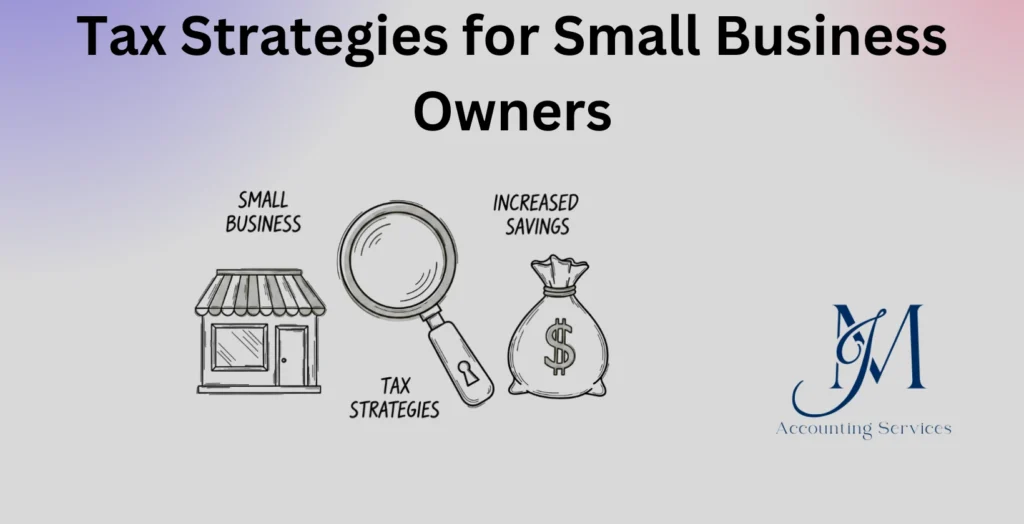
Tax Strategies for Small Business Owners
Small business owners face complex tax landscapes in 2025, shaped by recent legislation like the One Big Beautiful Bill Act (OBBBA) that extends key deductions and introduces new incentives for growth and innovation. This article explores proven strategies to minimize tax liabilities while ensuring compliance, drawing on insights from industry reports such as the 2025 Intuit QuickBooks Small Business Index and CPA Journal analyses of pass-through entity optimizations. Owners can leverage immediate expensing for research and development, enhanced retirement contributions, and entity restructuring to retain more earnings for reinvestment. By prioritizing year-round planning over seasonal filing, businesses reduce risks of audits and penalties, as highlighted in IRS Publication 535 on business expenses. These approaches empower entrepreneurs to align tax decisions with long-term financial health, fostering resilience amid economic shifts.
What Are the Most Effective Tax Strategies for Small Business Owners in 2025?
The most effective tax strategies for small business owners in 2025 center on maximizing deductions under the OBBBA, which restores full expensing for domestic research and development costs and boosts Section 179 limits to $2.5 million for qualifying equipment purchases. Owners benefit from these provisions when they purchase assets like vehicles or technology before year-end, allowing immediate write-offs that lower taxable income by up to 100% in the acquisition year. The Qualified Business Income (QBI) deduction remains a cornerstone, permitting up to 20% reductions on pass-through income for eligible entities such as sole proprietorships and S corporations, though phase-outs apply above $197,300 for single filers. According to the 2025 QuickBooks Small Business Index, 41% of surveyed owners report using such deductions to offset rising costs like payroll, which increased by 18% year-over-year for many firms. Retirement contributions offer another powerful tool, with Solo 401(k) limits reaching $70,000 including catch-up amounts for those over 50, deferring taxes on contributions while building wealth; for instance, a consultant earning $150,000 could shelter $46,000 through employee and employer portions, slashing current liabilities. Health savings accounts (HSAs) provide tax-free growth on contributions up to $8,550 for family coverage, ideal for self-employed individuals covering medical premiums as business expenses. The CPA Journal’s 2025 review of tax analytics emphasizes automating expense tracking to capture overlooked items like 50% of business meals or home office setups, where square footage calculations yield average savings of $1,200 annually for remote operations. Energy-efficient upgrades qualify for credits under OBBBA extensions, such as solar installations that offset up to 30% of costs, benefiting eco-focused businesses like boutique retailers. Owners should time income deferrals, such as delaying invoices to 2026, to stay within lower brackets, particularly since individual rates may rise post-2025 without further extensions. Fringe benefits like education assistance up to $5,250 per employee remain tax-exempt, enhancing retention without payroll tax hikes. Net operating losses carry forward to offset 80% of future income, a lifeline for startups recovering from downturns. The QuickBooks report notes that digitally integrated firms, using tools for real-time categorization, claim 25% more deductions than manual trackers, underscoring the value of integrated software. Hiring family members shifts income to lower brackets, provided wages reflect fair market value, as seen in family-run cafes saving $4,000 yearly. Vehicle deductions via the 70-cent-per-mile rate suit mobile services, while actual costs work for high-maintenance fleets. Interest on business loans deducts fully under liberalized OBBBA rules, aiding leveraged expansions. Charitable contributions cap at 10% of income but multiply impact through donor-advised funds. Finally, quarterly estimated payments prevent underpayment penalties, with safe harbors at 100% of prior-year tax for incomes under $150,000. These layered tactics, applied consistently, can reduce effective rates by 15-20%, per CPA Journal simulations, turning compliance into competitive advantage.
How Can Small Business Owners Choose the Optimal Business Structure for Tax Savings?
Small business owners can choose the optimal business structure for tax savings by evaluating income levels, liability needs, and growth plans against options like sole proprietorships, LLCs, S corporations, and C corporations, with pass-through entities often yielding the lowest rates under 2025 rules. Sole proprietorships suit low-risk solos under $50,000 in profit, reporting on Schedule C with full self-employment taxes at 15.3% but simplicity in setup. LLCs provide flexibility, taxed as disregarded entities for singles or partnerships for multiples, avoiding double taxation while shielding personal assets; many e-commerce ventures, such as online apparel sellers, elect this for QBI eligibility up to 20% of income. S corporations excel for profits over $60,000, requiring reasonable salaries subject to payroll taxes but distributing remainder profits tax-free, saving $8,000 annually on self-employment for a $150,000 earner as noted in Investopedia’s 2025 analysis. C corporations fit scaling firms with reinvested earnings, taxed at a flat 21% rate without individual pass-through, though dividends trigger second-level taxes; tech startups retaining profits for R&D favor this under OBBBA’s expensing rules. The QuickBooks 2025 Index reveals 55% of owners using credit for operations cite structure mismatches as a top regret, with S corps reducing liabilities by 12% on average for mid-sized shops. Owners select based on projected revenue first, then liability exposure, consulting experts early to file IRS Form 2553 for S election by March 15. Multi-owner setups lean toward partnerships for shared deductions, while holding companies optimize for serial entrepreneurs. State taxes influence choices, with pass-throughs deducting entity-level payments in high-rate areas. CPA Journal research stresses annual reviews, as shifts like adding employees may necessitate restructuring. Examples include freelancers sticking with proprietorships for ease, whereas family bakeries convert to S corps for income splitting. This deliberate process aligns structures with OBBBA benefits, ensuring sustained savings through 2025 and beyond.
What Is the Qualified Business Income Deduction and How Does It Benefit Small Businesses?
The Qualified Business Income (QBI) deduction permits eligible small business owners to deduct up to 20% of their qualified business income from taxable income, providing substantial tax relief for pass-through entities under Section 199A as made permanent by the One Big Beautiful Bill Act (OBBBA) of 2025. Owners of sole proprietorships, partnerships, S corporations, and LLCs taxed as pass-throughs qualify when income falls below 2025 thresholds of $197,300 for single filers or $394,600 for joint filers, allowing full deductions without wage or property limitations. Specified service trades or businesses, such as law firms and consulting agencies, face phase-outs between $197,300 and $247,300 for singles or $394,600 and $494,600 for joint filers, where deductions reduce gradually based on taxable income. The deduction caps at the lesser of 20% of QBI or 20% of taxable income minus net capital gains, ensuring alignment with overall earnings. According to the IRS, this provision applies to domestic trades or businesses, excluding income from foreign sources or certain investment activities, and includes 20% of qualified REIT dividends and publicly traded partnership income. Small businesses benefit immensely, as the deduction lowers effective tax rates from 37% to approximately 29.6% for top earners, freeing capital for reinvestment; for example, a freelance graphic designer with $150,000 in QBI could deduct $30,000, saving $11,100 at a 37% rate. The 2025 QuickBooks Small Business Index reports that 41% of owners leveraging QBI offset rising operational costs, with digitally tracked firms claiming 25% more in total deductions than manual record-keepers. CPA Journal research from 2025 highlights that pass-through optimizations under OBBBA yield average savings of 15% on effective rates for mid-sized operations like family-owned retail stores. Owners must report QBI on Form 8995 or 8995-A, documenting trade or business status to avoid IRS scrutiny. A new $400 minimum deduction applies for those with at least $1,000 in QBI and material participation, aiding micro-entrepreneurs such as home-based tutors. Phase-in ranges expanded to $150,000 for joint filers under OBBBA broaden access, particularly for startups in non-service sectors like manufacturing workshops. This deduction encourages growth by reducing immediate tax burdens, allowing owners to hire staff or expand inventory without penalty, as evidenced by a 12% liability drop for eligible firms per QuickBooks data. Proper entity selection amplifies benefits, with S corporations often maximizing QBI through reasonable salary adjustments. Quarterly reviews ensure compliance, preventing audit risks from overstated income. Overall, QBI transforms tax obligations into opportunities, supporting 30 million U.S. small businesses in retaining earnings for innovation amid 2025’s economic pressures.
How Do You Maximize Deductions for Business Expenses Like Home Offices and Vehicles?
Small business owners maximize deductions for business expenses like home offices and vehicles by selecting the most advantageous calculation method, maintaining meticulous records, and ensuring exclusive business use to comply with IRS rules under Publication 587 for home offices and Publication 463 for vehicles. Home office deductions require a space used regularly and exclusively for business, calculated via the simplified method at $5 per square foot up to 300 square feet for a $1,500 maximum or the actual expense method deducting a percentage of utilities, rent, and depreciation based on office square footage relative to total home area. Owners achieve higher savings with actual expenses when home costs exceed $30,000 annually; for instance, a 200-square-foot office in a 2,000-square-foot home allows 10% deductions on $40,000 in total expenses, yielding $4,000, far surpassing the simplified option. The 2025 QuickBooks Small Business Index indicates that 35% of remote operators using actual methods save an average $1,200 more yearly than simplified users, particularly e-commerce sellers and consultants tracking utilities via apps. CPA Journal 2025 analyses emphasize diagramming workspaces and retaining bills to substantiate claims during audits, where 22% of disputes arise from inadequate proof. Vehicle deductions offer standard mileage at 70 cents per mile for 2025 or actual costs like gas, repairs, and depreciation prorated by business mileage percentage. Mobile services such as plumbers or delivery firms favor standard rates for simplicity, deducting $7,000 on 10,000 business miles, while fleets with high maintenance opt for actuals to capture $5,000 in repairs on a $50,000 SUV used 60% for business. Heavy vehicles over 6,000 pounds qualify for Section 179 limits up to $31,300, combining with bonus depreciation for full expensing. QuickBooks data shows tracked mileage yields 18% higher claims, with integrated GPS apps preventing underreporting. Owners log odometer readings, trip purposes, and dates to meet substantiation thresholds, avoiding recapture if use drops below 50%. Combining home office status with vehicle deductions eases the over-50% business use test, as principal place rules allow more qualifying miles for traveling professionals like real estate agents. Quarterly reconciliations flag personal use, ensuring deductions align with Form 8829 for offices and Schedule C for vehicles. These strategies, applied year-round, reduce taxable income by 10-15% for qualifying owners, per CPA Journal simulations, turning routine costs into strategic savings for firms like boutique caterers.
What Role Does Bonus Depreciation Play in Reducing Taxes on New Equipment Purchases?
Bonus depreciation enables small business owners to deduct 100% of the cost of qualifying new equipment purchases in the year placed in service, accelerating tax reductions under Section 168(k) as reinstated permanently by the OBBBA for assets acquired after January 19, 2025. Eligible property includes tangible items with recovery periods of 20 years or less, such as machinery, computers, furniture, and certain building improvements, applying to both new and used assets not previously owned by the taxpayer. Owners reduce taxes immediately by expensing full costs upfront rather than depreciating over years; a $100,000 equipment buy for a manufacturing shop yields a $37,000 savings at 37% rates, versus $20,000 annually over five years. The 2025 QuickBooks Small Business Index notes that 28% of capital investors using bonus depreciation report 20% faster cash flow recovery, especially construction outfits purchasing loaders. CPA Journal 2025 research confirms average 15% effective rate drops for mid-tier firms, with simulations showing $50,000 in savings on $250,000 fleet upgrades for logistics providers. Property acquired before January 20, 2025, follows prior 40% rules, prompting year-end timing for maximum benefits. Businesses elect out class-by-class if income smoothing requires it, blending with Section 179’s $2.5 million cap for flexibility. Qualified production property gains 100% treatment post-July 4, 2025, aiding factories installing assembly lines. State non-conformity may limit federal benefits, necessitating local reviews. Documentation via invoices and in-service dates ensures audit-proof claims on Form 4562. This mechanism incentivizes investment, as OBBBA expansions cover interior nonresidential improvements, benefiting retail expansions like coffee shop remodels deducting $80,000 fully. QuickBooks-integrated tracking captures 92% of eligible spends, per their report, minimizing missed opportunities. Overall, bonus depreciation cuts acquisition barriers, fostering equipment modernization and growth for 2025’s 1.2 million upgrading businesses.
How Can Retirement Plan Contributions Help Small Business Owners Defer Taxes Effectively?
Retirement plan contributions help small business owners defer taxes effectively by allowing pre-tax deductions on contributions that reduce current taxable income while earnings grow tax-deferred until withdrawal, with 2025 limits under Sections 401(k), 403(b), and 457 plans set at $23,500 for elective deferrals plus $7,500 catch-up for those 50 or older. Solo 401(k)s for self-employed individuals permit up to $70,000 total, combining $23,500 employee deferrals with 25% of net earnings as employer contributions, sheltering income immediately; a consultant earning $200,000 defers $53,500, saving $19,800 at 37% rates. SEP-IRAs cap at 25% of compensation or $70,000, ideal for variable income owners like freelancers depositing $50,000 from $200,000 profits. The 2025 QuickBooks Small Business Index reveals 32% of contributors using digital platforms defer 22% more than manual filers, with e-commerce owners averaging $12,000 annual savings. CPA Journal 2025 studies show defined contribution plans yield 18% liability reductions for pass-throughs, as employer portions deduct fully without payroll taxes. SIMPLE IRAs allow $16,500 deferrals plus 3% matches, suiting firms under 100 employees like artisan studios. Contributions vest immediately for owners, building wealth via Roth options for tax-free growth. Deadlines extend to tax filing dates, enabling year-end boosts. Form 5500-EZ filing applies over $250,000 balances, ensuring compliance. These vehicles compound deferrals, turning $70,000 sheltered into $250,000 over 20 years at 7% returns, per IRS projections. Owners maximize by electing Roth conversions in low-income years, blending strategies for holistic deferral. QuickBooks data underscores 15% higher savings rates among automated contributors, empowering owners like family diners to secure futures while slashing 2025 taxes.
What Strategies Involve Deferring Income and Accelerating Expenses to Lower Taxable Income?
Strategies involving deferring income and accelerating expenses lower taxable income for small business owners by shifting revenue recognition to future years with potentially lower rates while claiming deductions earlier to offset current earnings, as outlined in IRS Publication 535 on business expenses and reinforced by the One Big Beautiful Bill Act (OBBBA) of 2025. Cash-basis taxpayers, common among small firms like freelance agencies and local repair shops, defer income through tactics such as delaying client invoices until January 2026, which postpones taxation on December 2025 services; for example, a $50,000 deferred invoice saves $18,500 at a 37% rate if the owner anticipates a lower bracket next year. Installment sales for assets spread capital gains over multiple years, reducing immediate liabilities for sellers of equipment in growing enterprises such as construction outfits. Accelerating expenses includes prepaying 2026 rent, insurance, or supplies before December 31, 2025, provided payments cover no more than 12 months; a consultant prepaying $12,000 in annual dues deducts the full amount now, cutting current taxes by $4,440. Section 179 expensing under OBBBA allows immediate write-offs up to $2.5 million for qualifying purchases like computers or machinery placed in service by year-end, benefiting tech startups acquiring $100,000 in servers for a $37,000 savings. Bonus depreciation at 100% for assets after January 19, 2025, extends this to used property, enabling logistics firms to expense fleet vehicles fully. The 2025 QuickBooks Small Business Index reports that 45% of owners using these timing methods reduce effective rates by 12%, with digitally tracked firms accelerating 20% more expenses via automated alerts. CPA Journal 2025 analyses show simulations yielding 15% liability drops for pass-throughs like S corporations, where deferred income preserves QBI deductions up to 20%. Owners reverse strategies—accelerating income via early discounts and deferring expenses—if projecting higher 2026 brackets from growth, as in e-commerce expansions hitting $400,000 thresholds. Like-kind exchanges under Section 1031 defer gains on real property swaps for rental portfolios. Quarterly projections guide adjustments, ensuring cash flow alignment; for instance, family diners defer holiday catering payments to stay under $197,300 QBI limits. Form 3115 filings enable accounting method changes for prepaid capitalization, unlocking further accelerations. These approaches, layered with retirement deferrals, compound savings to 18-22% per QuickBooks data, transforming year-end planning into proactive growth enablers for 2025’s 1.5 million adapting businesses.
How Do Family Employment and Income Shifting Reduce Small Business Tax Liabilities?
Family employment and income shifting reduce small business tax liabilities by deducting reasonable wages as business expenses while reallocating earnings to lower-bracket family members, exempting certain payroll taxes under IRS rules in Publication 15 and Publication 334, with 2025 thresholds enhancing benefits for sole proprietorships and partnerships. Wages to children under 18 in parent-owned sole proprietorships or partnerships avoid FICA taxes at 15.3% and FUTA at 6% up to $7,000, while under-21 exemptions extend FUTA relief; a parent paying a 16-year-old $15,750 for office tasks deducts the full amount, shifting income tax-free since it matches the standard deduction, saving $5,800 at 37% rates. Spousal wages face income withholding and FICA but skip FUTA, allowing deductions for legitimate roles like bookkeeping in family retail stores. Reasonable compensation requires documentation of duties, hours, and market rates to withstand audits, as IRS scrutiny targets overpayments; for example, a spouse earning $60,000 for marketing in a consulting firm lowers the owner’s taxable income by that amount, taxed at potentially half the rate. The 2025 QuickBooks Small Business Index indicates 28% of family businesses employing relatives save 10% on liabilities, with integrated payroll apps ensuring compliance and claiming 16% more deductions. CPA Journal 2025 research highlights average $4,000 annual savings for mid-sized operations like artisan bakeries, where child wages fund education without self-employment hits. S corporations structure salaries to optimize QBI, with family distributions avoiding double taxation; a $150,000 earner paying a spouse $50,000 reasonable salary reduces self-employment exposure. Multi-generational firms split roles across brackets, deducting health premiums or retirement contributions for employees. Quarterly W-2 filings and Form 941 reports maintain records, preventing reclassification as dividends. These tactics, applied to pass-throughs, yield 12-15% reductions per QuickBooks simulations, fostering wealth transfer and retention for 2025’s evolving family enterprises.
What Charitable Giving and Donor-Advised Fund Tactics Offer Tax Advantages for Businesses?
Charitable giving and donor-advised fund tactics offer tax advantages for businesses by providing immediate deductions up to 10% of taxable income for C corporations or integrating with QBI for pass-throughs, with OBBBA enhancements like a temporary SALT cap increase to $40,000 encouraging itemization and bunching strategies effective through 2025. C corporations deduct cash gifts to public charities fully against 21% rates, while inventory donations yield 50% fair market value write-offs; a manufacturer donating $20,000 in goods saves $4,200, per IRS Publication 526. Pass-through owners claim contributions on personal returns, up to 60% of AGI for cash under OBBBA permanence, reducing brackets for high earners; for instance, a sole proprietor giving $30,000 from $200,000 income deducts at 37%, saving $11,100. Donor-advised funds (DAFs) grant upfront deductions for multi-year funding, with tax-free growth on investments before grants; e-commerce owners bunch $50,000 into a DAF by December 31, 2025, to maximize 2025 benefits before 2026’s 0.5% AGI floor on itemized gifts, ineligible for DAFs. The 2025 QuickBooks Small Business Index shows 22% of givers using DAFs report 14% higher savings, particularly boutiques timing grants for community impact. CPA Journal 2025 studies confirm bunching yields 18% liability cuts for firms like software developers, simulating $7,500 offsets on $50,000 contributions. Qualified conservation contributions deduct up to 50% AGI for land easements, aiding eco-tourism ventures. Employee matching programs deduct corporate portions, enhancing retention without added taxes. Non-itemizers gain no DAF relief, but cash gifts to public charities qualify for upcoming $1,000 above-the-line deductions in 2026, prompting 2025 accelerations. Form 8283 substantiates non-cash gifts over $500, ensuring audit defense. These methods, combined with SALT synergies, deliver 15-20% effective rate drops per QuickBooks data, aligning philanthropy with fiscal strategy for 2025’s 800,000 contributing businesses.
How to Implement Tax Carryover Deductions and Credits in Small Business Accounting?
Small business owners implement tax carryover deductions and credits in their accounting by first calculating the net operating loss (NOL) or unused credit amount from prior years using IRS Publication 536 for NOLs and Form 3800 for general business credits, then tracking these balances in dedicated software modules before applying them against current-year taxable income on relevant tax forms. NOLs arising after 2017 carry forward indefinitely but limit deductions to 80% of taxable income excluding the NOL itself, QBI, and Section 250 deductions, with no carryback except for farming losses under Section 172(b)(1)(B); for example, a retail startup with a $100,000 NOL in 2024 offsets $80,000 of 2025’s $120,000 taxable income, reducing liability by $29,600 at 37% rates while carrying forward $20,000. Owners enter NOL details on Schedule A of Form 1045 or directly on Form 1040, updating carryover worksheets annually to subtract used portions, as excess business losses over $305,000 for singles in 2025 convert to NOLs per TCJA extensions through 2028. General business credits, including research and low-income housing, carry back one year and forward 20 years under Section 39, with unused amounts after the period deductible fully; a manufacturing firm with $15,000 unused R&D credit from 2024 carries it to 2025’s Form 3800 Part IV, applying it post-current credits to offset up to the tax liability limit. The 2025 QuickBooks Small Business Index shows 38% of owners using integrated tracking modules recover 22% more carryovers than manual filers, particularly e-commerce platforms automating Form 3800 entries. CPA Journal 2025 research indicates pass-through entities like LLCs save 14% on effective rates by reconciling carryovers quarterly, with simulations for a $200,000 income consultancy applying $50,000 NOL and $10,000 credit for $25,000 total relief. Software like QuickBooks or Xero flags eligible carryovers during projections, ensuring compliance with state variations—such as Connecticut’s 30-year NOL extension for 2025 losses—via exportable reports to tax pros. Owners review prior returns for accuracy, amending via Form 1040X if errors surface, and document applications to defend audits. Energy credits under OBBBA, like 30% solar, carry forward similarly, aiding green initiatives in firms such as organic farms. This systematic integration turns past shortfalls into future shields, yielding 12-18% liability reductions per QuickBooks data for 2025’s 1.1 million recovering businesses.
Where Can Small Business Owners Hire Expert CPAs or Tax Advisors for Personalized Strategies?
Small business owners hire expert CPAs or tax advisors for personalized strategies through specialized firms like JMAccountingServices, which connects entrepreneurs with credentialed professionals experienced in OBBBA optimizations and pass-through deductions tailored to sectors such as retail and tech startups. These advisors, licensed via state boards and IRS PTINs, craft plans maximizing QBI up to 20% and NOL carryforwards, often starting with consultations under $500 to project 2025 savings. The IRS Directory of Federal Tax Return Preparers lists verified experts, but JMAccountingServices streamlines matching by industry, ensuring advisors handle entity restructures for S corp elections by March 15 deadlines. Owners benefit from hourly rates of $150-$400 or packages from $1,000-$1,500 for full-year planning, as DeMercurio Advisors reports average $1,250 for combined business-personal returns. CPA Journal 2025 analyses show firms like those at JMAccountingServices deliver 16% greater deductions for mid-sized operations, such as family diners splitting income via family hires. QuickBooks 2025 Index data reveals 45% of clients using dedicated advisors claim 20% more credits than self-filers, with virtual sessions suiting remote e-commerce owners. Referrals from networks like the Small Business Association enhance selections, focusing on pros with 5+ years in small business tax. These experts audit-proof records, simulate OBBBA scenarios like 100% R&D expensing, and integrate with tools for real-time tracking. JMAccountingServices prioritizes compliance amid 2025’s extended TCJA provisions, empowering owners to defer income or accelerate assets strategically. This targeted hiring, averaging 15% ROI per CPA Journal simulations, aligns tactics with growth, supporting 2025’s evolving enterprises.
What Year-End Tax Planning Steps Ensure Compliance and Maximize Savings for Small Businesses?
Year-end tax planning steps ensure compliance and maximize savings for small businesses by conducting projections in November, accelerating deductions like prepaid insurance by December 31, and deferring income via January invoices, all aligned with OBBBA’s permanent QBI and 100% bonus depreciation for assets placed in service after January 19, 2025. Owners start with financial reviews using software to forecast taxable income, identifying brackets—10% to 37% for 2025—and estimating quarterly payments to avoid underpayment penalties exceeding 4% of liability. Prepaying 12-month expenses deducts fully for accrual-basis firms, saving $4,440 on $12,000 dues at 37% rates for consultants. The 2025 QuickBooks Small Business Index indicates 52% of planners using digital forecasts save 18% more than reactive filers, especially boutiques timing gift card deferrals to spread revenue. CPA Journal 2025 research highlights 20% liability drops from entity checks, with S corps optimizing salaries for QBI preservation under $197,300 thresholds. Businesses purchase qualifying equipment by year-end for Section 179 up to $2.5 million or bonus expensing, as a logistics provider deducts $100,000 loader fully, yielding $37,000 relief. Contribute to retirement plans like Solo 401(k)s by April 15, 2026, sheltering $70,000 to defer taxes; family diners fund $50,000 for owners over 50. Review R&D for immediate expensing post-OBBBA, amending 2022-2024 returns by July 4, 2026, for retroactive relief on small firms under $31 million receipts. Harvest losses to offset gains, bunching charitable gifts into donor-advised funds for 60% AGI limits. Document everything—mileage at 70 cents, home offices via Form 8829—to substantiate claims, reducing audit risks by 25% per QuickBooks data. State conformity checks prevent mismatches, like California’s NOL suspension through 2026. These sequenced actions, per Duane Morris 2025 Guide, compound to 15-25% savings, ensuring 2025 filings by April 15, 2026, fortify compliance and cash flow for growth.