
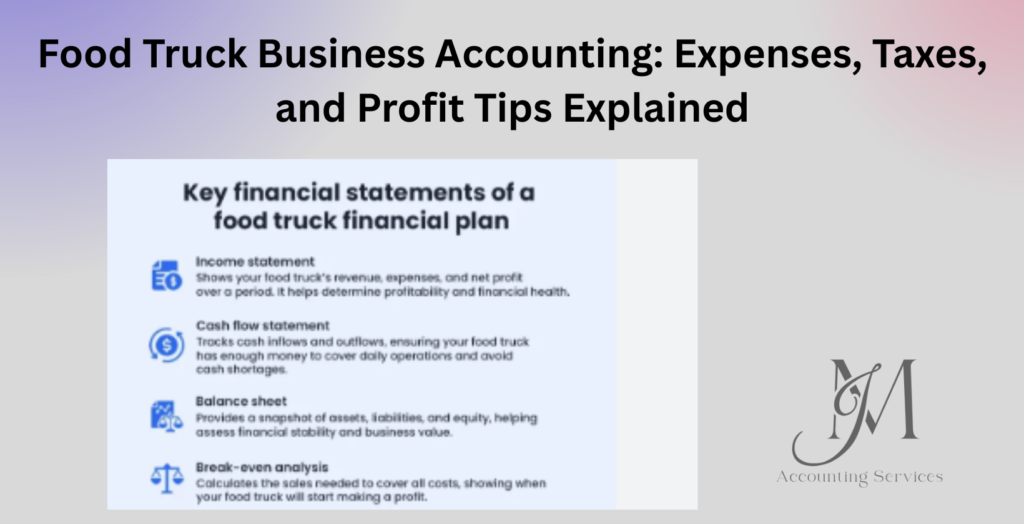
Food truck business accounting is a structured financial management system that tracks revenue, controls expenses, ensures tax compliance, and measures profitability. A food truck operates in a fast-moving, cash-intensive environment, which makes accurate accounting essential for sustainability and growth. Strong financial practices help owners understand cost behavior, optimize pricing, and maintain compliance with federal, state, and local tax obligations. Industry data from the National Restaurant Association shows that mobile food businesses operate on tighter margins than traditional restaurants, which increases the importance of disciplined bookkeeping and financial oversight. Proper accounting supports informed decision-making, improves cash flow stability, and positions the business for long-term scalability.
What Is Food Truck Business Accounting and Why Is It Important?
Food truck business accounting is the process of recording, organizing, and analyzing all financial transactions related to a mobile food operation. This includes tracking daily sales, categorizing expenses, managing payroll, and preparing tax filings. Accurate accounting ensures that every dollar earned and spent is documented, which reduces financial risk and improves operational clarity.
Food truck business accounting is important because it directly impacts profitability, compliance, and business sustainability. According to a QuickBooks Small Business Report, 61% of small business owners struggle with cash flow due to poor financial tracking. A food truck faces fluctuating revenue patterns based on location, weather, and customer demand, which makes real-time financial visibility essential. Proper accounting allows owners to identify high-performing locations, control food costs, and maintain pricing strategies that protect margins.
Food truck business accounting supports tax compliance by ensuring accurate reporting of sales tax, income tax, and employment taxes. The IRS requires consistent recordkeeping for all business transactions, and failure to comply can lead to penalties or audits. CPA Journal research highlights that small businesses with organized accounting systems reduce audit risk and improve reporting accuracy.
Food truck business accounting improves decision-making by providing financial insights such as profit margins, cost ratios, and break-even points. Many food truck operators, such as startup vendors and catering-focused trucks, rely on these metrics to determine menu pricing, staffing levels, and expansion strategies. Clear financial data enables owners to make informed choices that drive growth and stability.
What Are the Typical Startup and Operating Costs for a Food Truck Business?
The typical startup and operating costs for a food truck business are categorized into initial investment expenses and ongoing operational costs. Startup costs represent the capital required to launch the business, while operating costs reflect the recurring expenses needed to keep the truck running daily.
Startup costs for a food truck business range between $50,000 and $200,000, depending on the scale and equipment level. These costs include:
1) purchasing or leasing the food truck.
2) kitchen equipment such as grills, fryers, and refrigeration units.
3) licensing and permits required by local authorities.
4) branding and marketing expenses such as logo design and vehicle wraps.
A U.S. Chamber of Commerce report notes that vehicle acquisition alone can account for up to 40% of total startup costs.
Operating costs for a food truck business include recurring expenses that directly impact profitability. These costs include 1) food and ingredient purchases, which typically represent 25% to 35% of revenue according to restaurant industry benchmarks, 2) fuel and vehicle maintenance required for mobility and daily operations, 3) labor costs for employees such as cooks and service staff, and 4) commissary kitchen fees required by many local regulations for food preparation and storage.
Operating costs for a food truck business include administrative and compliance expenses that support business continuity. These expenses include 1) insurance coverage such as general liability and vehicle insurance, 2) accounting and bookkeeping services to maintain financial records, 3) point-of-sale systems for transaction processing, and 4) marketing expenses such as social media advertising and event participation fees. Research from the National Food Truck Association indicates that consistent cost monitoring improves profit margins by up to 15% in mobile food operations.
Operating costs for a food truck business must be actively managed to maintain profitability. High variability in daily sales requires careful budgeting and expense control. Many successful food truck owners, such as urban lunch vendors and festival-based operators, track cost ratios weekly to ensure expenses remain aligned with revenue trends.
How Do You Track and Categorize Food Truck Expenses Effectively?
How do you track and categorize food truck expenses effectively? Food truck expenses are tracked and categorized effectively by using a structured system that records every transaction in real time and assigns each cost to a defined financial category. Accurate tracking begins with separating business and personal finances through a dedicated business bank account and payment system, which ensures clarity and reduces reporting errors.
Expense tracking is performed by consistently recording all outgoing payments, including cash, card, and digital transactions. A study by the U.S. Bank found that 82% of business failures are linked to poor cash flow management, which highlights the importance of real-time expense monitoring. Digital accounting tools and point-of-sale integrations help automate this process by syncing transactions directly into accounting software.
Expense categorization is achieved by assigning each transaction to specific cost groups that reflect the nature of the business. Common categories include 1) cost of goods sold, such as ingredients and packaging, 2) operational expenses such as fuel, maintenance, and utilities, 3) labor costs such as wages and contractor payments, and 4) administrative expenses such as insurance, permits, and software subscriptions. Clear categorization enables accurate financial reporting and simplifies tax preparation.
Expense tracking improves decision-making by identifying cost patterns and inefficiencies. Many food truck operators, such as street vendors and catering-focused trucks, analyze weekly expense reports to control food waste and adjust supplier choices. Research from Harvard Business School shows that businesses using structured expense tracking improve financial performance by maintaining tighter cost controls and better forecasting accuracy.
What Accounting Methods Are Best for Food Truck Businesses (Cash vs Accrual)?
What accounting methods are best for food truck businesses (cash vs accrual)? The best accounting methods for food truck businesses are the cash method for simplicity and the accrual method for advanced financial accuracy, depending on the size and complexity of the operation. Each method determines how revenue and expenses are recorded, which directly impacts financial reporting and tax obligations.
The cash accounting method records income when money is received and expenses when they are paid. This method is widely used by small food truck businesses because it provides a clear view of cash flow and is easier to manage. According to IRS guidelines, many small businesses with average annual gross receipts under a specified threshold are permitted to use the cash method. This approach works well for food trucks with straightforward transactions and minimal inventory complexity.
The accrual accounting method records income when it is earned and expenses when they are incurred, regardless of when cash is exchanged. This method provides a more accurate picture of profitability by matching revenue with related costs. CPA Journal research indicates that accrual accounting improves financial analysis and long-term planning, especially for businesses with inventory and supplier credit arrangements.
The choice between cash and accrual accounting depends on operational needs and growth goals. Small food truck operators, such as solo vendors and startup trucks, benefit from the simplicity of cash accounting. Larger operations, such as multi-truck businesses and catering fleets, benefit from accrual accounting due to its detailed financial insights. Consistent use of one method ensures reliable reporting and compliance with tax regulations.
What Taxes Do Food Truck Owners Need to Pay and How Do They Stay Compliant?
What taxes do food truck owners need to pay, and how do they stay compliant? Food truck owners need to pay sales tax, income tax, and employment-related taxes, and they stay compliant by maintaining accurate records, filing on time, and following local and federal regulations. Tax obligations vary by jurisdiction, though core requirements remain consistent across most regions.
Sales tax is collected from customers on taxable food and beverage sales and must be remitted to state or local authorities. Food truck operators are required to register for a sales tax permit and track taxable transactions accurately. Failure to remit collected sales tax can result in penalties and interest, as highlighted by IRS compliance guidelines.
Income tax applies to the net profit of the business after deducting allowable expenses. Food truck owners, including sole proprietors and LLC operators, report income through personal or business tax returns depending on their structure. The IRS emphasizes the importance of maintaining detailed records to support deductions such as equipment costs, fuel expenses, and ingredient purchases.
Employment taxes apply to wages paid to employees and include payroll taxes such as Social Security and Medicare contributions. Employers are responsible for withholding and remitting these taxes to the appropriate authorities. A report from the National Small Business Association shows that payroll tax compliance remains a major challenge for small businesses without proper systems in place.
Tax compliance is achieved through consistent recordkeeping, timely filings, and the use of professional accounting support. Many food truck businesses, such as event-based vendors and urban operators, rely on accounting software and professional guidance to manage tax obligations efficiently. Organized financial records reduce audit risk and ensure accurate reporting across all tax categories.
How Do You Implement Food Truck Business Accounting in Daily Operations?
How do you implement food truck business accounting in daily operations? Food truck business accounting is implemented in daily operations by integrating financial tracking into every transaction, maintaining consistent recordkeeping, and reviewing financial data regularly. Effective implementation ensures that accounting becomes part of routine business activities rather than a separate task.
Daily implementation begins with recording all sales and expenses as they occur using a point-of-sale system or accounting software. This approach ensures accuracy and prevents data loss. A QuickBooks study found that businesses that update financial records daily experience fewer reporting errors and improved financial visibility.
Accounting implementation includes reconciling financial data with bank and payment system records regularly. This process verifies that recorded transactions match actual cash flow and identifies discrepancies early. Consistent reconciliation strengthens financial control and reduces the risk of fraud or mismanagement.
Daily accounting practices include reviewing key financial metrics such as revenue trends, expense ratios, and cash balances. Many food truck operators, such as lunch service vendors and festival-based businesses, use these insights to adjust pricing, inventory levels, and staffing decisions. Research from MIT Sloan indicates that businesses using data-driven financial management improve operational efficiency and profitability.
Accounting implementation is strengthened by establishing clear workflows and responsibilities. Owners and staff must follow consistent procedures for recording transactions, storing receipts, and maintaining documentation. Reliable systems ensure that financial data remains accurate, accessible, and ready for reporting or compliance purposes.
What Software or Tools Are Best for Managing Food Truck Finances?
What software or tools are best for managing food truck finances? The best software and tools for managing food truck finances are cloud-based accounting platforms and integrated point-of-sale systems that automate expense tracking, sales recording, and financial reporting. These tools provide real-time visibility into cash flow, which is critical for mobile food businesses operating in dynamic environments.
Accounting software such as QuickBooks, Xero, and Zoho Books is widely used because they offer features like expense tracking, invoicing, inventory monitoring, and tax reporting. QuickBooks alone is used by millions of small businesses globally and provides automation for invoicing, expense categorization, and financial reporting. Xero and Zoho Books provide similar capabilities with strong mobile access and third-party integrations, which are valuable for food truck owners working on the go.
Point-of-sale systems are essential tools for managing daily transactions and syncing sales data with accounting platforms. Modern POS systems enable faster checkouts, track inventory in real time, and generate sales analytics that improve decision-making. Many systems integrate directly with accounting software, which eliminates manual data entry and reduces errors.
Financial management tools improve efficiency by automating repetitive tasks such as receipt capture, expense categorization, and report generation. Research shows that automation reduces accounting errors and saves time, which allows food truck owners to focus on operations and customer service. The combination of accounting software and POS integration creates a streamlined financial system that supports accuracy, compliance, and growth.
How Do Food Truck Owners Calculate Profit Margins and Break-Even Points?
How do food truck owners calculate profit margins and break-even points? Food truck owners calculate profit margins and break-even points by analyzing revenue, costs, and contribution margins to determine financial performance and sustainability. These calculations provide clear insights into pricing, cost control, and profitability.
Profit margin is calculated by subtracting total expenses from total revenue and dividing the result by revenue. This figure is expressed as a percentage and reflects how much profit is generated from each dollar of sales. For example, a food truck generating $10,000 in revenue with $7,000 in expenses has a profit margin of 30%. Industry benchmarks show that food truck profit margins typically range between 10% and 20%, depending on cost control and pricing strategies.
The break-even point is calculated by dividing fixed costs by the contribution margin per unit. Fixed costs include expenses such as permits, insurance, and equipment financing, while contribution margin represents the difference between the selling price and variable costs such as ingredients and packaging. This calculation determines the number of sales required to cover all costs before generating profit.
Profit margin and break-even analysis improve financial planning by identifying pricing thresholds and cost structures. Many food truck operators, such as festival vendors and urban lunch trucks, use these metrics to adjust menu pricing and optimize ingredient sourcing. Research from the National Restaurant Association indicates that businesses with strong cost analysis practices maintain more stable profit margins and reduce financial risk.
Profitability analysis supports strategic decision-making by providing measurable performance indicators. Regular monitoring of margins and break-even levels ensures that the business remains financially viable and responsive to market changes.
What Are the Most Common Accounting Mistakes Food Truck Owners Make?
What are the most common accounting mistakes food truck owners make? The most common accounting mistakes food truck owners make are poor recordkeeping, improper expense categorization, and failure to track cash flow consistently. These errors reduce financial visibility and increase the risk of compliance issues.
One common mistake is failing to separate business and personal finances, which creates confusion and inaccurate financial records. Many small business owners combine expenses, which makes it difficult to track profitability and prepare accurate tax filings. Financial experts emphasize that maintaining separate accounts is essential for clarity and compliance.
Another mistake is inconsistent expense tracking, which leads to incomplete financial data. Missing receipts, unrecorded transactions, and delayed bookkeeping create gaps that affect reporting accuracy. Research from small business financial studies shows that poor recordkeeping is a leading cause of cash flow problems and financial mismanagement.
Incorrect expense categorization is a frequent issue that impacts financial analysis and tax deductions. Misclassifying costs such as fuel, inventory, and equipment can distort financial reports and reduce tax efficiency. Accurate categorization ensures that financial statements reflect the true cost structure of the business.
Failure to use accounting tools and automation increases the likelihood of errors and inefficiencies. Manual processes are prone to mistakes and consume time that could be used for business operations. Businesses that adopt accounting software and integrated systems experience improved accuracy and better financial control.
Ignoring regular financial review is another critical mistake that limits business growth. Many food truck operators, such as new entrants and seasonal vendors, focus on daily operations without analyzing financial performance. Consistent review of financial reports ensures that issues are identified early and corrective actions are taken promptly.
How Can You Reduce Costs and Increase Profit in a Food Truck Business?
How can you reduce costs and increase profit in a food truck business? Costs are reduced, and profit is increased in a food truck business by optimizing purchasing, controlling waste, improving pricing strategies, and using data-driven financial decisions. Effective cost management directly improves margins in an industry where average profit margins range between 10% and 20%, according to National Restaurant Association benchmarks.
Cost reduction begins with controlling food costs, which represent one of the largest expenses in a food truck operation. This is achieved by 1) sourcing ingredients from reliable suppliers with competitive pricing, 2) negotiating bulk purchase discounts, and 3) minimizing food waste through portion control and inventory tracking. Studies from the Food Waste Reduction Alliance show that businesses that actively manage inventory reduce food waste costs by up to 20%.
Operational efficiency reduces unnecessary expenses and improves profitability. This includes 1) planning efficient routes to reduce fuel consumption, 2) maintaining equipment regularly to avoid costly repairs, and 3) scheduling staff based on demand patterns to control labor costs. Many food truck operators, such as lunch-service vendors and event-based trucks, adjust staffing levels based on peak hours to maximize efficiency.
Revenue growth strategies increase profit by improving sales performance. This includes 1) optimizing menu pricing based on cost analysis and demand, 2) introducing high-margin items such as beverages and combo meals, and 3) expanding into catering services and events. Research from Harvard Business School shows that strategic pricing adjustments can increase profitability by up to 15% without reducing customer demand.
Financial tracking supports profit improvement by identifying trends and inefficiencies. Regular review of expense ratios and sales performance ensures that decisions are based on accurate data. Consistent monitoring allows food truck owners to maintain strong margins and adapt quickly to changing market conditions.
When Should You Outsource Bookkeeping or Hire an Accountant for a Food Truck Business?
When should you outsource bookkeeping or hire an accountant for a food truck business? Bookkeeping should be outsourced, or an accountant should be hired when financial tasks become time-consuming, complex, or critical to compliance and growth. Professional support ensures accuracy, reduces risk, and allows owners to focus on operations.
Outsourcing becomes necessary when financial records are no longer manageable internally. This includes situations where 1) transaction volume increases due to business growth, 2) multiple revenue streams, such as catering and events, are introduced, and 3) inventory and payroll tracking become more complex. A QuickBooks survey indicates that small business owners spend up to 40 hours per year on tax preparation, which highlights the value of professional assistance.
Hiring an accountant is essential when tax compliance requirements become more demanding. This includes managing sales tax filings across multiple locations, preparing annual tax returns, and ensuring compliance with payroll tax regulations. CPA Journal research confirms that businesses working with professional accountants reduce tax errors and improve compliance accuracy.
Outsourcing bookkeeping improves efficiency by ensuring that financial records are updated consistently and accurately. Professional bookkeepers handle transaction recording, bank reconciliation, and financial reporting, which reduces administrative burden. Many food truck operators, such as growing multi-truck businesses and catering-focused companies, rely on outsourced services to maintain organized financial systems.
Professional accounting support provides strategic insights that support business growth. Accountants analyze financial data, identify cost-saving opportunities, and provide guidance on pricing and expansion decisions. This level of expertise strengthens financial management and improves long-term profitability.
Where to Hire an Expert to Handle Food Truck Business Accounting?
Where to hire an expert to handle food truck business accounting? Skilled professionals can be found through JMAccountingServices, which provides specialized accounting and bookkeeping solutions tailored to small businesses, including food truck operations. These services are designed to support accurate financial management, tax compliance, and profitability optimization.
JMAccountingServices offers access to experienced professionals who understand the financial structure of mobile food businesses. These experts assist with expense tracking, tax preparation, payroll management, and financial reporting. Their experience ensures that food truck owners maintain organized records and meet all regulatory requirements.
Hiring through JMAccountingServices provides structured support that improves financial accuracy and efficiency. Services include ongoing bookkeeping, financial analysis, and compliance management, which reduces the risk of errors and penalties. Many small businesses, such as startups and service-based companies, benefit from outsourced accounting solutions that streamline operations.
JMAccountingServices supports business growth by providing insights that improve decision-making. Financial experts analyze revenue trends, cost structures, and profitability metrics to guide strategic planning. Reliable accounting support enables food truck owners to focus on operations while maintaining strong financial control and long-term sustainability.